
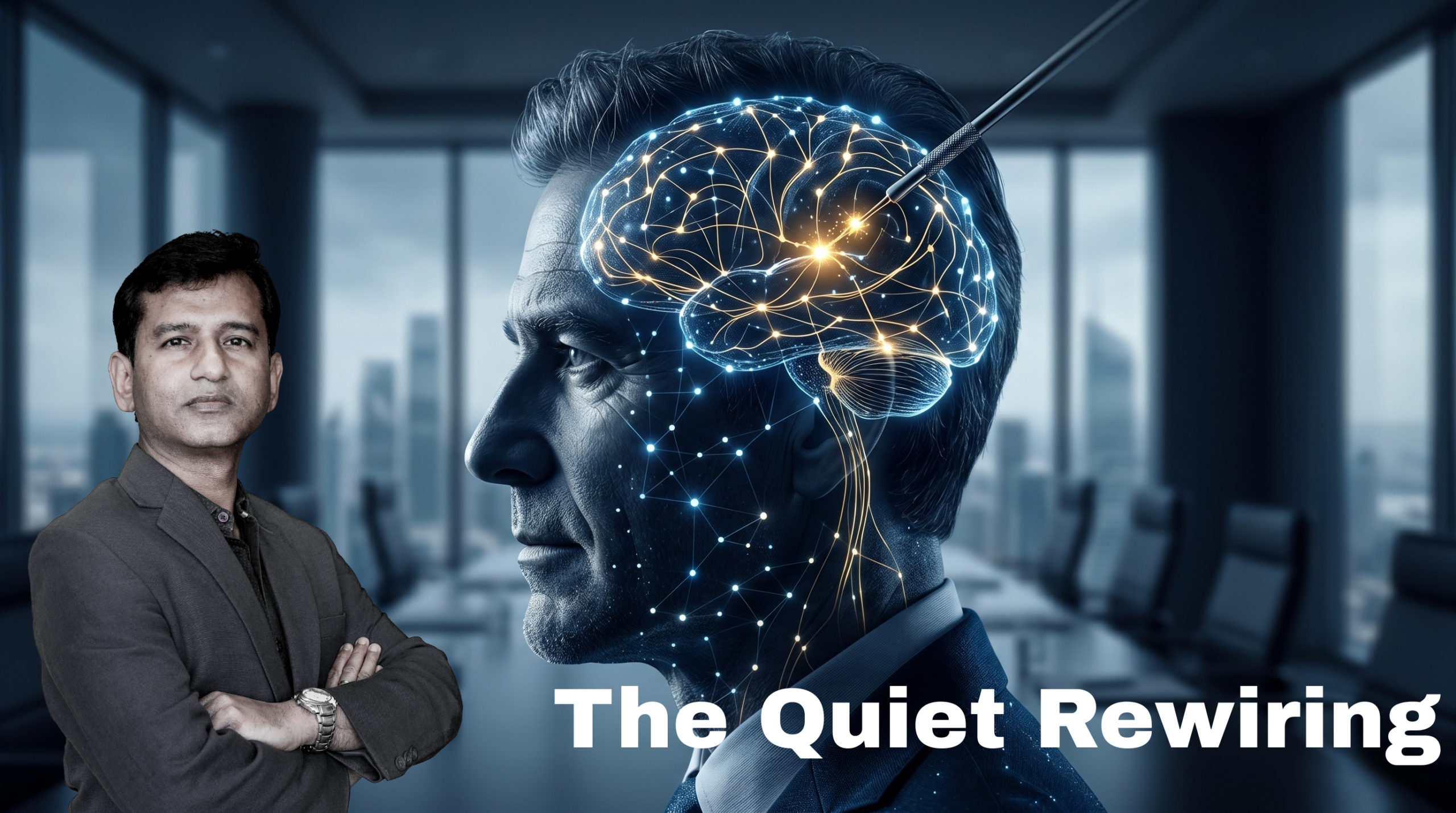
Guest post by Dr. Ankoor Dasguupta
Let me start this with a metaphor. Think of a seasoned pilot mid-flight, cruising at 35,000 feet. The route is familiar, the instruments are functioning, and the destination is known. Yet, beneath this apparent stability, subtle shifts in air currents begin to emerge, micro-turbulences that are not immediately visible but can alter the trajectory over time. An inexperienced pilot reacts to each disturbance. A seasoned one relies on deeper calibration, reading signals that are not obvious, adjusting with precision rather than impulse. Executive coaching, at its most evolved form, operates like that invisible calibration system, refining perception rather than prescribing direction. There are coaches in various niche. So, choose your coach after your own research and a chemistry call.
In the life of a senior C-suite executive, complexity is not situational; it is embedded. Decisions are layered, feedback is often curated, and the margin for cognitive error is narrow. At this altitude of leadership, what becomes scarce is not expertise or intelligence, it is uninterrupted clarity of thought. This is where the role of a coach becomes both nuanced and profound. A coach does not expand the executive’s repository of knowledge; instead, they deepen the executive’s access to it, particularly under pressure, ambiguity, and scrutiny.
At this level, leadership effectiveness is less about solving problems and more about how problems are constructed cognitively. Framing determines direction. And framing, as cognitive science suggests, is shaped by neural pathways built over decades of experience. These pathways, while efficient, are also self-reinforcing. Success, in many ways, hardens them. What has worked repeatedly becomes default thinking. Over time, this creates a paradox: the very mental models that enabled success can begin to constrain perspective.
This is where executive coaching intersects meaningfully with the science of neuroplasticity, the brain’s capacity to reorganize itself by forming new neural connections. In leadership contexts, neuroplasticity is not about learning something new in the conventional sense; it is about interrupting the automaticity of thinking. It is about enabling the leader to respond differently to the same stimuli.
1. Precision Questioning – The Catalyst for Cognitive Rewiring
The instrument for this rewiring is not advice, but precision questioning. Unlike conventional questioning that seeks answers, coaching questions are designed to disrupt cognitive continuity. They introduce what neuroscientists might call a ‘prediction error’, a moment where the brain’s habitual pattern does not fully resolve the situation. This creates a cognitive pause, a brief but powerful space where new neural pathways can begin to form.
Consider a senior executive in a high-stakes boardroom disagreement. Years of experience may instinctively guide them toward control, assertion, or strategic withdrawal. A coach, however, might introduce a question such as: “What certainty are you holding onto that may not be serving you here?” or “If this situation were not about resolution, what else might it be asking of you?” These are not questions meant to elicit immediate answers. They are designed to create productive and reflective dissonance.
It is within this space of dissonance that neuroplasticity quietly operates. The brain, momentarily dislodged from its familiar pathways, is compelled to explore alternative interpretations. With repeated exposure to such inquiry, these alternative pathways begin to strengthen. Over time, what was once an effortful shift becomes a natural cognitive option. The executive’s thinking does not slow down it becomes more layered, adaptive, and self-aware.
2. Internally Generated Insight Over External Advice
A critical nuance here is that the coach does not impose new frameworks of thinking. At the C-suite level, externally imposed models often fail due to contextual misalignment. Instead, coaching facilitates internally generated insights. These insights carry greater cognitive legitimacy, they are more likely to be trusted, retained, and acted upon. In essence, the coach becomes a catalyst for the executive’s own cognitive evolution rather than a provider of solutions.
Equally important is the role of coaching in introducing cognitive deceleration within high-velocity environments. Senior leaders are often rewarded for speed rapid decision-making, swift responses, decisive action. However, many strategic missteps arise not from lack of information, but from premature cognitive closure. Coaching creates deliberate pauses moments where reflection precedes reaction. This enables what can be described as second-order thinking: the ability to anticipate consequences beyond the immediate horizon.
3. Reframing Uncertainty Through Curiosity
Another dimension, often understated, is how coaching reshapes an executive’s relationship with uncertainty. At senior levels, ambiguity is not an exception; it is a constant. Traditional leadership approaches attempt to minimize uncertainty. Coaching, in contrast, enhances the leader’s capacity to engage with it. Through sustained inquiry, the internal narrative begins to shift from seeking control to cultivating curiosity.
This shift has a neurological basis. Curiosity activates the brain’s reward systems, transforming ambiguity from a source of threat into a domain of exploration. Over time, executives begin to approach complex, undefined situations with a different internal posture not one of resistance, but of engagement. This fundamentally alters how decisions are made and how risks are evaluated.
The implications of such cognitive shifts extend beyond the individual leader. At the suite level, leadership is inherently systemic. The quality of an executive’s thinking influences organizational culture, strategic direction, and collective behavior. Leaders who have expanded their cognitive flexibility through coaching often foster environments where inquiry is valued over assertion, reflection over immediacy, and learning over defensiveness. Yet, the essence of coaching lies in its subtlety. It does not manifest in overt interventions or visible transformations. Its impact is observed in quieter moments in a leader choosing to pause before responding, reframing a challenge before acting, or listening beyond the surface of a conversation. These micro-shifts, over time, compound into profound leadership evolution.
Reflection: The Invisible Recalibration
Executive coaching, therefore, is less about transformation in the dramatic sense and more about reconfiguration at the level of thought. It does not change the identity of the leader; it refines the pathways through which the leader accesses judgment, perception, and action.
To return to the metaphor of flight, if leadership is the journey and experience is the aircraft, then I’d say that coaching is not the co-pilot giving directions. It is all about the coachee and the unseen recalibration of the navigation system itself. It ensures that even in invisible currents, shifting pressures, and uncertain skies, the leader is not merely reacting to conditions, but navigating them with heightened awareness.
And perhaps, more profoundly, coaching is akin to the slow reshaping of a river beneath the surface, where the course does not change abruptly, but through persistent, almost invisible shifts in flow. Over time, the direction is altered, the depth is redefined, and the journey, though familiar, leads to a different destination altogether.
Written by Dr. Ankoor Dasguupta. If you would like to speak to Dr. Ankoor Dasguupta, he is available for a 1 on 1 consultation on Sprect.