
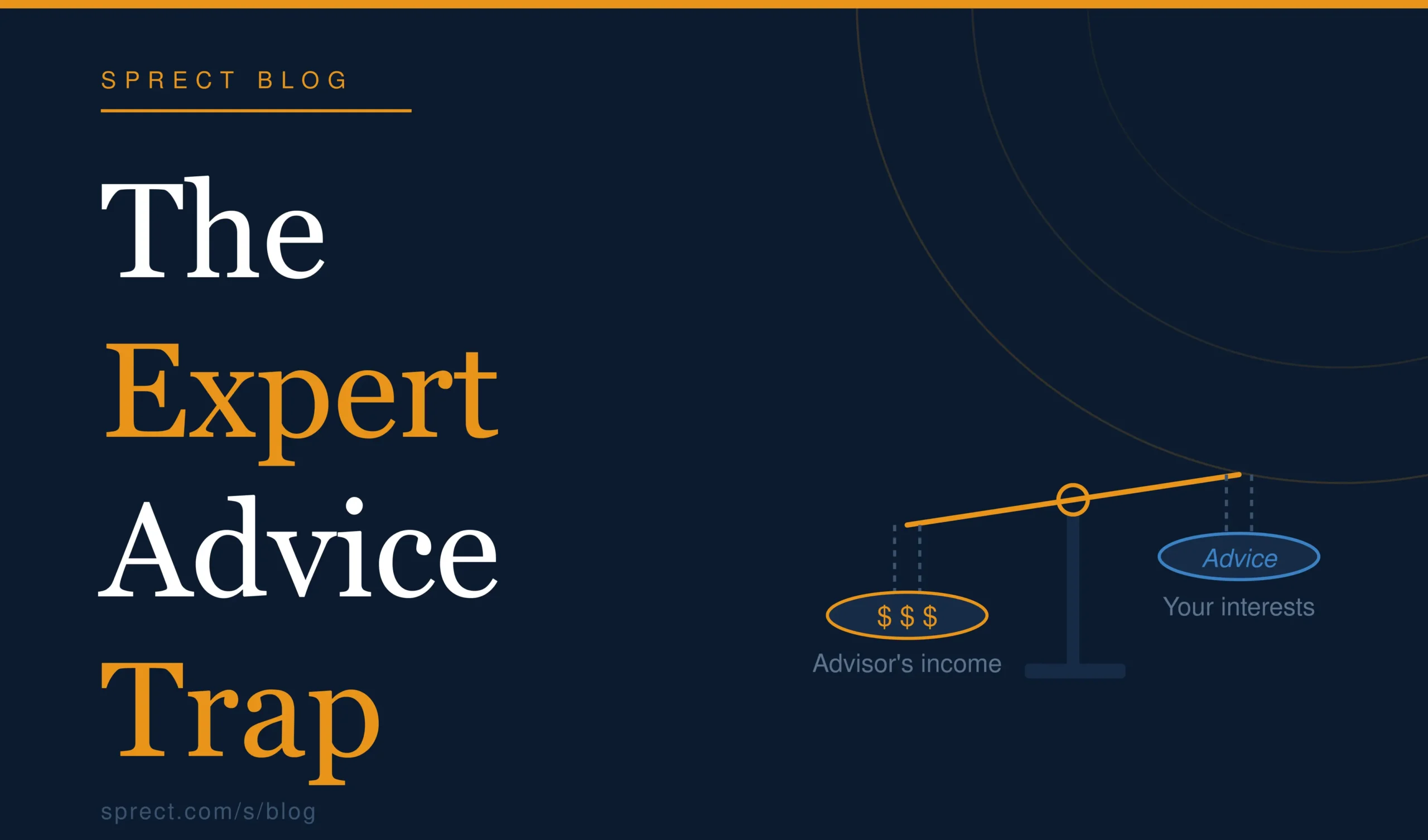
There is a peculiar irony baked into the way knowledge is distributed in any industry. The people who know the most about a subject are almost always the same people who earn a living from it. And the moment someone earns a living from something, their advice on that subject is colored — whether they intend it or not — by the shape of their own interest.
This is not a character flaw. It is simply how incentive structures work. But it creates a quiet, persistent problem for every business owner, founder, freelancer, and professional trying to make a good decision in unfamiliar territory. The cost of that problem — measured in bad decisions, wasted money, and months lost to trial and error — is enormous. It is also almost entirely invisible, because no one books the expense of advice they never got.
The Social Media Trap
A business owner wants to grow on Instagram or LinkedIn. They read a few articles, get overwhelmed by contradictory advice, and decide to speak to someone who actually understands the space. The obvious candidates are social media agencies or marketing consultants who specialize in these platforms.
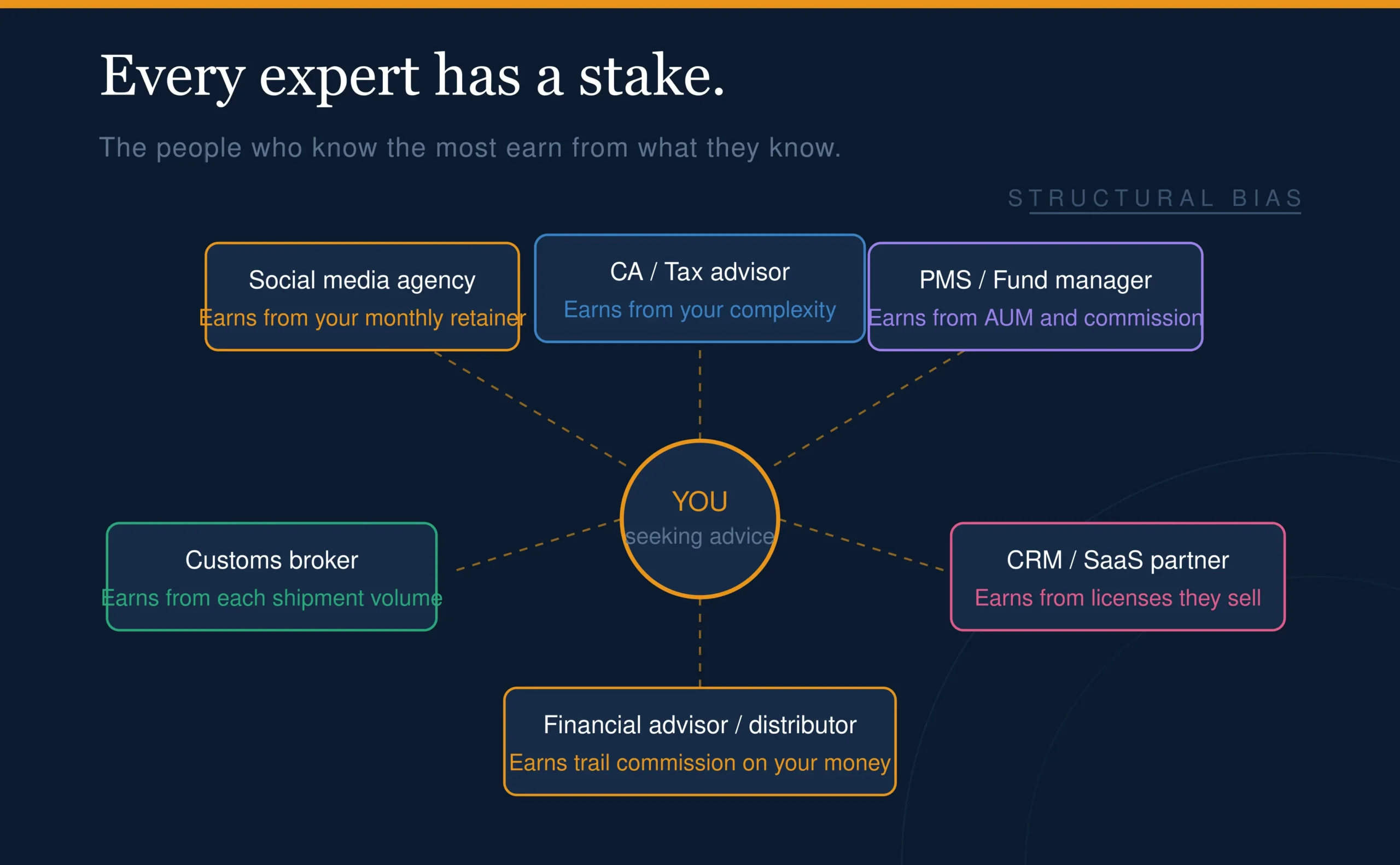
Here is the problem: every social media agency makes money by running your accounts, managing your content calendar, placing your ads, and retaining you as a monthly client. Their entire business model depends on you believing that social media is complex enough to require ongoing, outsourced management. When you sit down for a “free consultation” with an agency, you are not getting an independent view of whether you need them. You are getting a sales conversation dressed as advice.
The person who would give you genuinely unbiased advice — whether to invest in paid ads, which platforms actually match your audience, which metrics are vanity and which are real — is not someone who benefits from your spending. That person rarely comes forward voluntarily, because there is no business model that rewards them for doing so.
The Financial Advice Problem: Who Is Actually on Your Side?
Ask a mutual fund distributor which fund to buy. Ask a PMS (Portfolio Management Service) manager whether you should be in a PMS or a direct equity portfolio. Ask a life insurance advisor whether you need a ULIP or a term plan. In every case, the person answering has a financial stake in the answer.
In India, where commission-based financial advisory is still the dominant model, this problem is particularly sharp. A distributor earns a trail commission on every rupee you keep invested in a fund. A PMS manager earns a management fee and often a performance fee on top. A bank relationship manager has quarterly targets tied to products sold. The regulatory push toward fee-only advisory exists precisely because this conflict has been documented extensively — but fee-only advisors remain a small fraction of the market.
The result is that most retail investors and small business owners who turn to financial professionals for guidance on capital allocation, treasury management, or personal wealth get advice that is shaped — consciously or not — by what earns the advisor the most. An independent voice, one with no product to sell and no commission to earn, is genuinely hard to find. When found, it is rarely free.
Talk to a CFO who has no product to sell. Jignesh Kenia is a CFO, Angel Investor, and M&A strategist who has worked across multiple industries. A focused 30-minute conversation on your financial structure, investment decisions, or capital planning costs a fraction of what a wrong call would. Book a call with Jignesh Kenia
The CA and GST Labyrinth
For a growing business, the Goods and Services Tax regime is one of the most consequential and genuinely complex systems to navigate. The rules around input tax credit, reverse charge mechanism, zero-rated exports, LUT filings, GSTR reconciliation, and annual returns require real expertise. The same is true for income tax planning, transfer pricing, and TDS compliance.
The natural place to turn is a Chartered Accountant. And here the structural tension becomes particularly nuanced. A CA who handles your compliance does not benefit from simplifying your structure. Their billing is often tied to the complexity and volume of work they manage for you. A CA who might tell you in an honest 30-minute conversation that your current GST structure is fine and you are overcomplicating things would be reducing their own billing potential by saying so.
The advice you want — which CA software is adequate for your size of business, whether you truly need a full-time CA retainer or whether periodic consultation would suffice, which compliance decisions are genuinely complex versus which are routine — is most honestly given by someone who will never become your CA. Someone who earns their value entirely from the conversation, not from the ongoing engagement.
A retired Principal Chief Commissioner of Income Tax, on call. Nai Pal Singh has spent decades inside the tax system and has seen every structure, every dispute, every classification argument from the department’s own perspective. That view — in a focused session — is worth more than a generic compliance proposal from a firm chasing new clients. Book a call with Nai Pal Singh
The Import-Export Maze and the Customs Broker’s Dilemma
A manufacturer or trader looking to enter export markets faces a thicket of compliance: IEC codes, shipping bills, LUT filings under GST, ECGC insurance, FIRC documentation for foreign remittances, DGFT licenses, HSN classifications, and country-specific import duties at the destination. For first-time exporters, this is genuinely disorienting.
The obvious guide is a customs broker or freight forwarder. These are essential service providers in the trade ecosystem — but their incentive structure rewards volume and complexity. A customs broker earns on each shipment. A freight forwarder earns on the logistics arrangement. Neither is structurally motivated to tell you that your DGFT compliance is straightforward for your product category, or that a simpler Incoterms structure would reduce your risk.
The person who could save a first-time exporter months of confusion and several lakhs in unnecessary fees is someone who has walked this path inside a large Indian export business — someone who knows where the traps are from direct experience, not from commission flows.
The CRM and Software Selection Problem
Every year, thousands of businesses in India evaluate CRM platforms, accounting software, HR systems, and project management tools. The decision involves real money, long-term data migration costs, and the inertia of team habit once a system is embedded.
The ecosystem of people who can guide this decision is almost entirely composed of people with a stake in it. Implementation partners earn on the licenses they sell and on the implementation projects they run. Software vendors have their own salespeople. Consultants who specialize in enterprise software often have certifications that make them most naturally aligned with one or two platforms.
When a company asks a Zoho partner whether Zoho is right for them, they are not getting an impartial comparison with Salesforce or HubSpot. The unbiased voice would be a person who has evaluated and implemented multiple CRM systems across different business contexts, who has no partnership with any vendor, and who earns nothing from what you ultimately choose.
The Favor Economy and Its Limits
One natural workaround for all of this is the personal network. Ask a friend who runs a business. Call a former colleague who spent years in the relevant function. Reach out to a senior professional you met at a conference.
This works, up to a point. But it carries its own problems. Asking someone for substantive professional advice as a favor puts both parties in an uncomfortable position. The asker is conscious of imposing on someone’s time and expertise. The responder gives a quick, hedged answer, because giving a thorough one feels like work they are not being paid for. The relationship dynamic shapes the content of the advice.
More fundamentally, your network is shaped by where you have been, not where you are trying to go. A founder building their first business in import-export has spent years building relationships in their previous career, not in trade compliance. The specific expert you actually need is rarely someone you already know.
The On-Demand Auditor Model
There is a way to think about this problem that makes the solution clearer. Every large company has an external auditor. The auditor’s entire value proposition rests on independence. They have no interest in the company’s ongoing business model. Their incentive is to tell the truth as they see it, because their reputation depends on doing so.
Most businesses do not think to apply this model to anything other than statutory compliance. But the logic extends to every consequential decision a business makes. Before choosing a social media agency, the equivalent of an independent audit would be a conversation with an experienced marketer who has no agency to sell. Before locking into a CRM platform, the audit would be a conversation with someone who has evaluated these systems across multiple contexts.
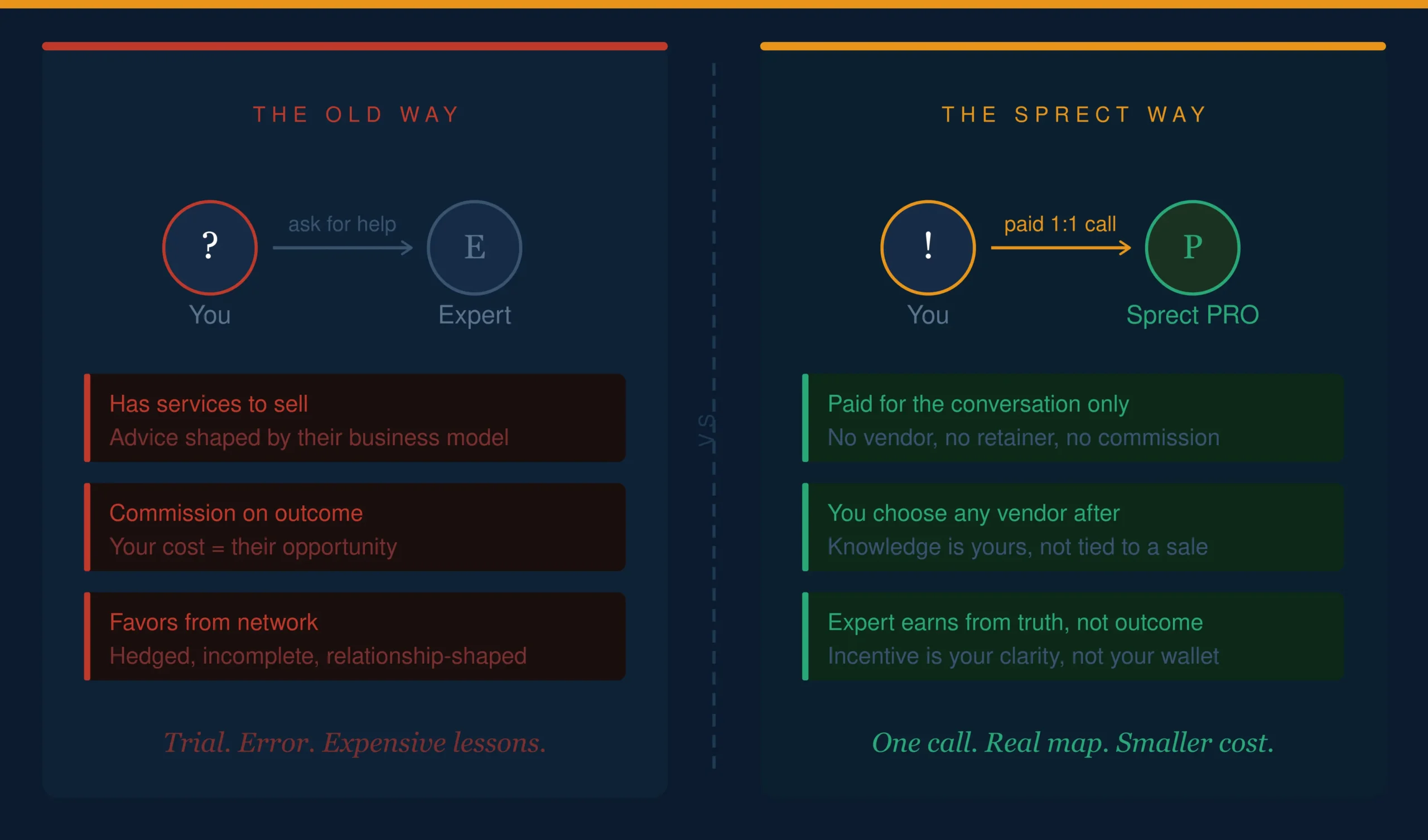
Paid expert consultation — structured as a short, focused, compensated conversation rather than an ongoing retainer — functions as exactly this kind of audit. The payment matters, because it shifts the entire dynamic. The expert has been compensated for the conversation itself. There is nothing else to sell. The user walks away with knowledge, not with a vendor relationship. They are then entirely free to choose whatever service provider, software, or approach they find best, armed with the map that the expert drew.
This is the problem that Sprect, India’s first multilingual knowledge marketplace, is working to solve. The platform connects anyone who needs expert guidance with verified professionals across industries, for private, structured 1:1 video calls. No ongoing retainers. No vendor relationships. No agency sales funnels. The PRO earns from the conversation. The user gains knowledge they can act on with any provider they choose.
For digital growth and LinkedIn strategy — Keyur Kumbhare works specifically on digital growth and founder personal branding. An honest read on your social media situation, with no incentive to pitch an agency contract. sprect.com/pro/keyurkumbhare
For finance and business accounting clarity — Mohit Keswani, with experience at GSK Pharma, Mondelez, and Budweiser, helps business owners and professionals demystify finance — at rates starting at Rs. 100 for a 10-minute conversation. sprect.com/pro/mohitkeswani
The Real Cost of Getting This Wrong
The invisible cost in most business decisions is not the money spent. It is the money spent going down the wrong path and then having to course-correct. A company that chooses the wrong CRM does not just pay the licensing cost. It pays the implementation cost, the training cost, the productivity loss during transition, and eventually the migration cost to the system they should have started with.
A first-time exporter who gets the GST structure wrong on their first shipment may not discover the error until the ITC refund is rejected months later. A founder who commits to a social media agency for a year before realizing the channel is not right for their business does not just lose the agency fees. They lose the year.
Against these costs, the price of a 30-minute conversation with the right person — someone who has no stake in the outcome and every reason to be direct — is almost absurdly small. The real question is not whether you can afford it. It is whether you can afford not to.
Talk to the right person before you decide.Browse verified professionals across finance, legal, trade, technology, marketing, and more. Short calls. Real knowledge. No agenda.