
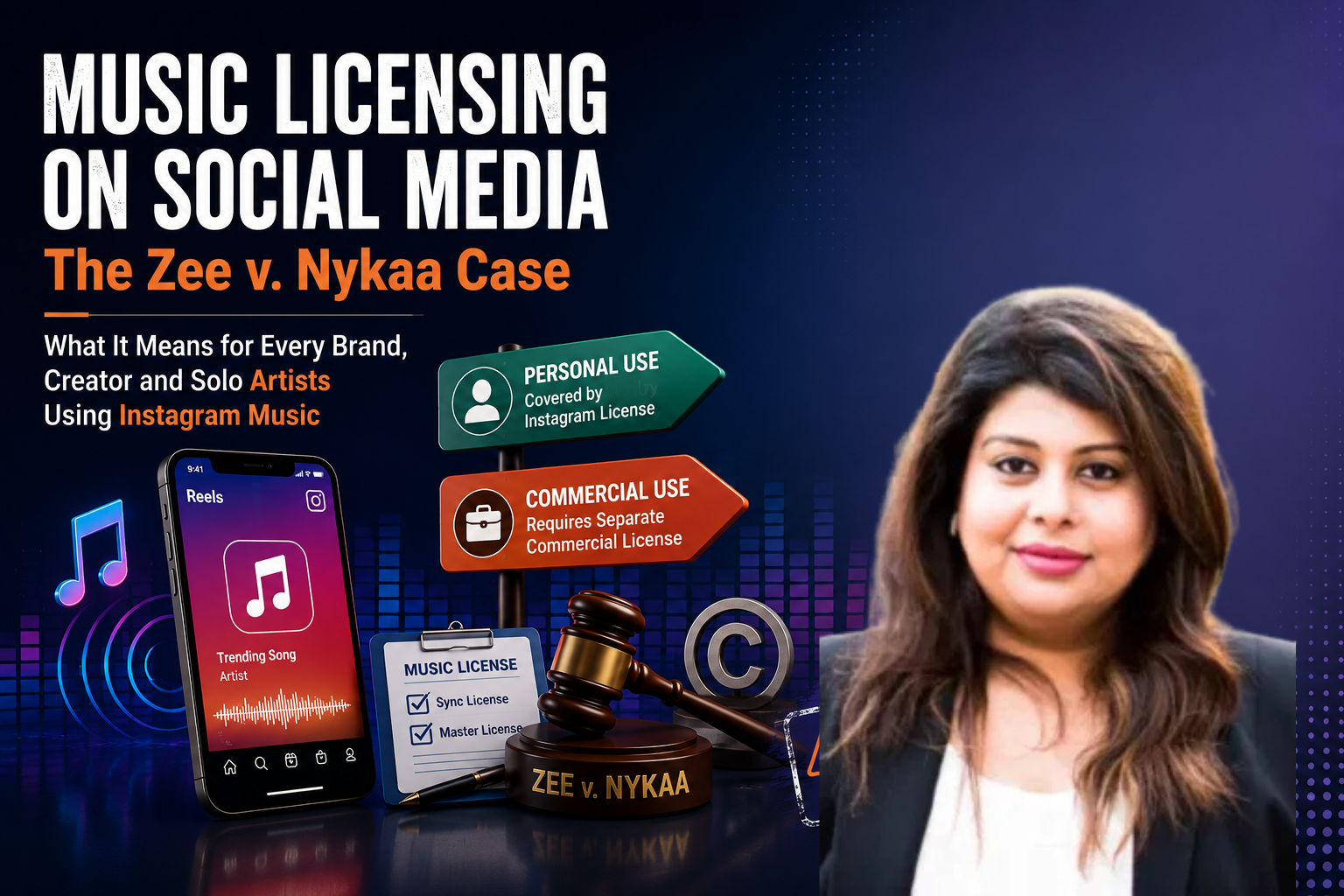
Guest Post By Janhvi Pradhan Deshmukh, Partner, Legasis Partners, Advocates and Solicitors, BKC, Mumbai
India’s creator economy runs on reels and reels, more often than not, run on music. For years, brands, influencers, fitness trainers, dance academies, wedding photographers, beauty consultants, and D2C founders have done the same thing: opened Instagram, tapped the audio icon, picked a trending Bollywood track and posted their promotional content. The music was right there, in the platform’s own library. It seemed licensed. It seemed safe. It was not.
The Case That Changed the Conversation
On April 3, 2026, Zee Entertainment Enterprises filed a lawsuit before the Delhi High Court against Nykaa, one of India’s most recognised beauty and fashion retail brands, alleging copyright infringement in respect of twelve Instagram reels. Zee claimed that Nykaa used songs from its catalogue as background music in promotional content without obtaining the requisite commercial licence. It sought damages of Rs. 2 crore (approximately $210,000 USD).
The Delhi High Court directed Nykaa to take down the disputed reels. The reels were pulled down.
Then, on May 19, 2026, Nykaa filed a further application seeking to make Meta, the parent company of Instagram, a formal party to the proceedings. In its filing, Nykaa argued that Meta alone can authoritatively state whether use of those music clips breached any licence terms, since the tracks were accessed directly from Instagram’s own in-app music library.
This case is no longer just about twelve reels. It is about the architecture of how music is licensed on social media platforms, who bears the legal risk when that architecture is unclear, and what it means for the hundreds of thousands of Indian brands and creators who use platform music every single day.
Understanding the Dispute: The Licensing Gap Nobody Told You About
To understand why this case matters, you first need to understand a distinction that Instagram’s interface does not make obvious and that Meta has historically been content to leave ambiguous.
There are, in law, two very different kinds of music use on Instagram.
The first is personal, non-commercial use. When an individual user, a student, a hobbyist, someone posting a birthday reel, picks a song from Instagram’s music library, they are covered. Meta has negotiated blanket licensing agreements with major music labels and publishers, including Zee Entertainment, under which those labels permit their catalogues to be used on Instagram for personal, non-commercial content. The platform has done the legal groundwork. The user is protected.
The second is commercial use. When a brand or any entity using Instagram to promote a product, service or business picks the same song from the same library, those blanket licensing deals do not cover them. The commercial use of copyrighted music in promotional content requires a separate synchronisation licence (a sync licence), negotiated directly with the rights holder. The fact that the platform made the track available does not mean the platform licensed it for commercial purposes.
Zee’s position in the Nykaa suit is precisely this. Zee acknowledges its licensing arrangement with Meta. It acknowledges that arrangement permits personal use. But it contends that Nykaa’s reels were promotional content tied to product marketing, and that such use required separate commercial authorisation that Nykaa never obtained.
This distinction is not new in law. What is new is that a major Indian rights holder has now tested it before the Delhi High Court, with screenshots, URLs and a two-crore damages claim.
The Meta Question: Platform Liability and the Section 79 Shield
Nykaa’s move to implead Meta is legally significant and strategically clever.
The core of Nykaa’s argument is simple: if the music was available in Instagram’s own library, and Instagram is Zee’s licensee, then the platform and not the user should be accountable for clarifying the boundaries of that licence. If Meta made tracks available to business accounts without restricting commercial use at the point of access, then Meta may have facilitated the infringement rather than merely hosted it.
This argument runs directly into Section 79 of the Information Technology Act, 2000, India’s safe harbour provision for intermediaries. Section 79 shields platforms like Meta from liability for third-party content, provided the platform does not initiate the transmission, does not select the receiver and does not modify the content. It also requires the platform to act expeditiously upon receiving actual knowledge of infringement.
The Delhi High Court has previously grappled with Meta’s conduct under this framework. In a separate matter, the Court reprimanded Meta in remarkably sharp terms, calling it “far worse than a government department” and directing it to put its house in order. The Court’s patience with Meta’s systems is not unlimited.
The critical question the Nykaa application raises is whether Meta’s conduct in making commercially restricted music available to business accounts without adequate disclosure takes it outside the passive intermediary role that Section 79 protects. If Meta actively curated, presented and facilitated access to music that it knew was not licensed for commercial use, the safe harbour argument becomes harder to sustain.
This is uncharted territory in Indian copyright jurisprudence. The outcome of the Meta impleadment application could reshape the accountability framework for social media platforms across India.
The JioStar Parallel: This Is Not an Isolated Case
It would be a mistake to treat the Nykaa suit as a one-off.
On April 14, 2026, Zee filed a separate and considerably larger suit against JioStar, the Reliance-Disney joint venture that owns JioHotstar, seeking $3 million in damages. Zee alleged that JioStar used music from its 19,450-song catalogue at least fifty times across music and dance shows on television and on the JioHotstar streaming platform, after licensing agreements expired in 2024 and 2025 and were not renewed due to commercial disagreements. The Delhi High Court directed JioStar to ensure no ongoing infringement within fifteen days.
Together, these two cases signal something important: Zee Entertainment has taken a deliberate strategic decision to enforce its music rights aggressively, across platforms and against parties of all sizes. The Nykaa case involves twelve reels on a social media platform. The JioStar case involves a streaming giant. The enforcement philosophy behind both is the same.
Music rights holders in India are no longer content to issue takedown notices and move on. They are litigating. And they are choosing defendants who make the points they want the courts to establish.
What This Means for Brands
If you are a brand, D2C or legacy, large or emerging, using Instagram reels as a promotional channel, this case is a direct conversation with your marketing and legal teams.
The issue is not whether the music appeared in Instagram’s library. The issue is whether your use of that music was commercial in nature. If the reel promoted your product, your service, your sale, your brand, or your event, it was commercial. Full stop.
The following categories of content are at risk: product launch reels with trending Bollywood tracks, seasonal sale announcements, brand awareness content, influencer collaborations where music from the platform library is used, compilation reels of products with popular audio, and any reel where the caption, visual or context makes clear that a business purpose is being served.
Many brand managers and social media teams operate on the assumption that because Instagram did not flag the content, it is safe. This is incorrect. Instagram’s content ID systems catch some infringement and miss much of it. The absence of a platform strike does not constitute a licence. Rights holders like Zee can monitor independently, identify commercial use and initiate proceedings without any prior platform-level action.
Others assume that because they use a Creator account rather than a business account, they are protected. This too is incorrect. The distinction that matters in law is not the account type; it is the nature of the content. If content promotes a commercial entity, it requires commercial licensing regardless of the account from which it is posted.
What This Means for Small Creators and Solo Businesses
This is where the conversation becomes genuinely urgent.
A dance workshop owner posting reels of her students to promote enrolments. A fitness trainer using a Bollywood track on a reel advertising batch timing. A wedding photographer posting a highlight reel with a popular song to showcase their portfolio. A home baker adding trending audio to a reel promoting their Diwali hampers. A handloom brand using film music to background a product showcase.
Every single one of these is commercial use. Every single one of them, under the current legal position, requires a synchronisation licence that the Instagram music library does not provide.
Most small creators are entirely unaware of this. They see the music, it is available in the app, they use it and they move on. The platform has never told them clearly that promotional use of their business, even at the smallest scale, falls outside the licensed use.
Zee v. Nykaa places this risk in sharp relief. While Nykaa has the resources to litigate this in the Delhi High Court and implead Meta, a dance workshop owner or a solo content creator does not. For them, a cease-and-desist letter or even a small claims proceeding could be existential. The stakes are disproportionate and that is precisely the problem.
The Legal Framework: What Licences Actually Apply
For clarity, here is what the law requires when music is used commercially.
A synchronisation licence, or sync licence, is required when music is paired with visual content, whether a reel, a video advertisement or a brand film. This licence is obtained from the music publisher, who controls the underlying musical composition and lyrics.
A master recording licence is required separately for use of the specific recorded version of a song, as opposed to the composition itself. This is typically held by the record label, in this case entities such as Zee Entertainment, T-Series or Sony Music. Both licences are required for a reel that uses a specific popular song. Instagram’s blanket deal with rights holders covers neither for commercial use.
Performing rights are required when music is performed publicly. In India, the collection societies for this are PPL (Phonographic Performance Limited) for sound recordings and IPRS (Indian Performing Right Society) for musical and literary works. These are relevant for live events and public performances, and worth noting for creators who also operate physical spaces or events.
Practical Steps: What Brands and Creators Must Do Now
The law will not wait for the Nykaa judgment to be finalised before rights holders send notices.
For established brands and marketing teams, the first step is an immediate audit of all existing social media content that uses music from platform libraries. Identify reels and videos that serve a promotional purpose and evaluate whether commercial use restrictions apply. Going forward, implement a clear internal policy: all content that promotes the brand, its products or its services must use only commercially cleared music. This means music from Meta’s Sound Collection, which offers over 14,000 royalty-free tracks cleared for commercial use, or music licensed from services such as Epidemic Sound, Artlist or Soundstripe. For campaigns that require a specific popular track, engage a music licensing professional to obtain the required sync and master licences directly from the rights holder. Ensure that contracts with influencers and content creators include explicit representations that all music used in brand-commissioned content is commercially licensed.
For small creators and solo businesses, the simplest and most immediate step is to switch to commercially safe music for any content that promotes your business. Meta’s own Sound Collection is available within the platform and is cleared for commercial use. Platforms like Epidemic Sound and Artlist offer subscription models designed for creators and small businesses, providing access to music that is pre-cleared for commercial use across social media platforms. If you have existing content using platform library music for promotional purposes, consider replacing the audio or taking it down proactively. A post that is no longer live cannot ground a damages claim. Document your music choices and keep records of where your audio came from, what licence applies and when you accessed it.
For influencer marketing agencies, every brief that involves client-commissioned content must include a music compliance requirement. Every piece of content delivered must come with confirmation of the music licensing chain. Agencies that do not build this into their processes face exposure as well.
The Bigger Question: Who Should Bear This Risk?
It would be incomplete to analyse this case without acknowledging the structural problem it exposes.
Meta benefits enormously from the engagement that music-driven content generates. Brands and creators produce reels with popular songs, engagement goes up, time on platform goes up, advertising revenue goes up. Meta’s licensing deals with rights holders were built, at least in part, on the back of this dynamic. Yet the platform’s interface makes no clear distinction between personal and commercial use at the point of access. A brand manager using Instagram’s music sticker sees the same tracks as a personal user. There is no warning, no pop-up, no restriction, no separate commercial licensing flow. The platform profits from but disclaims liability for the commercial use it facilitated.
Nykaa’s decision to implead Meta is, at one level, a litigation strategy. On another level, it is a legitimate question about platform accountability. If Meta’s music library is not available for commercial use, Meta should say so clearly, restrict access accordingly and provide a commercial licensing pathway within the platform itself. The fact that it has done none of these things is a product design and policy choice that has downstream legal consequences for thousands of users who relied on the platform’s implied permission.
The Delhi High Court now has the opportunity to examine this question directly. Whatever its conclusion, the answer will matter enormously, not just for Nykaa, but for every brand, creator and small business that has built its digital presence on the assumption that what the platform offers, the platform has cleared.
The Music Stopped. The Question Remains.
Nykaa took down twelve reels. The litigation continues.
Zee v. Nykaa is not, at its core, about a beauty brand and a media company. It is about a fundamental misunderstanding that has been systematically reinforced by platform design, inadequate disclosure and the assumption that if the platform allows it, the law permits it. That assumption is now before the Delhi High Court.
For brands of every size, for creators of every kind, for anyone who has ever added a Bollywood track to a promotional reel and pressed share, this case is the moment to pause, audit and correct course.
The music was in the library. The licence was not. In copyright law, that distinction costs crores. At minimum.
This article is intended for informational and educational purposes and constitutes general commentary on a matter of public legal interest. It does not constitute legal advice. For specific advice on music licensing, copyright compliance, or social media content strategy, please consult a qualified IP counsel.
Janhvi Pradhan Deshmukh is a Partner at Legasis Partners, Advocates and Solicitors, BKC, Mumbai, where she heads the Corporate, Commercial, Media and IP Practice.
If you would like to speak to Janhvi, she is available for a 1 on 1 consultation on Sprect.